
New feedstock & frontier

Our partners

Academia Integrator

Industry Partner

Incubator

About SpaceForm
Changing the feedstock to break through AM limits and bottlenecks.
Originally developed for in-space manufacturing and the constraints of microgravity, SpaceForm’s technology replaces powder recoating with controlled deposition of suspensions – redefining AM capabilities. This vacuum native process aims to enable complex geometries, smooth multi-material transitions, and significantly reduces the need for support structures. At the same time, it will open the door to use lower-cost, non-spherical, and alternative powders – both for in-space and terrestrial applications.

Multi-material
One platform, endless possibilities
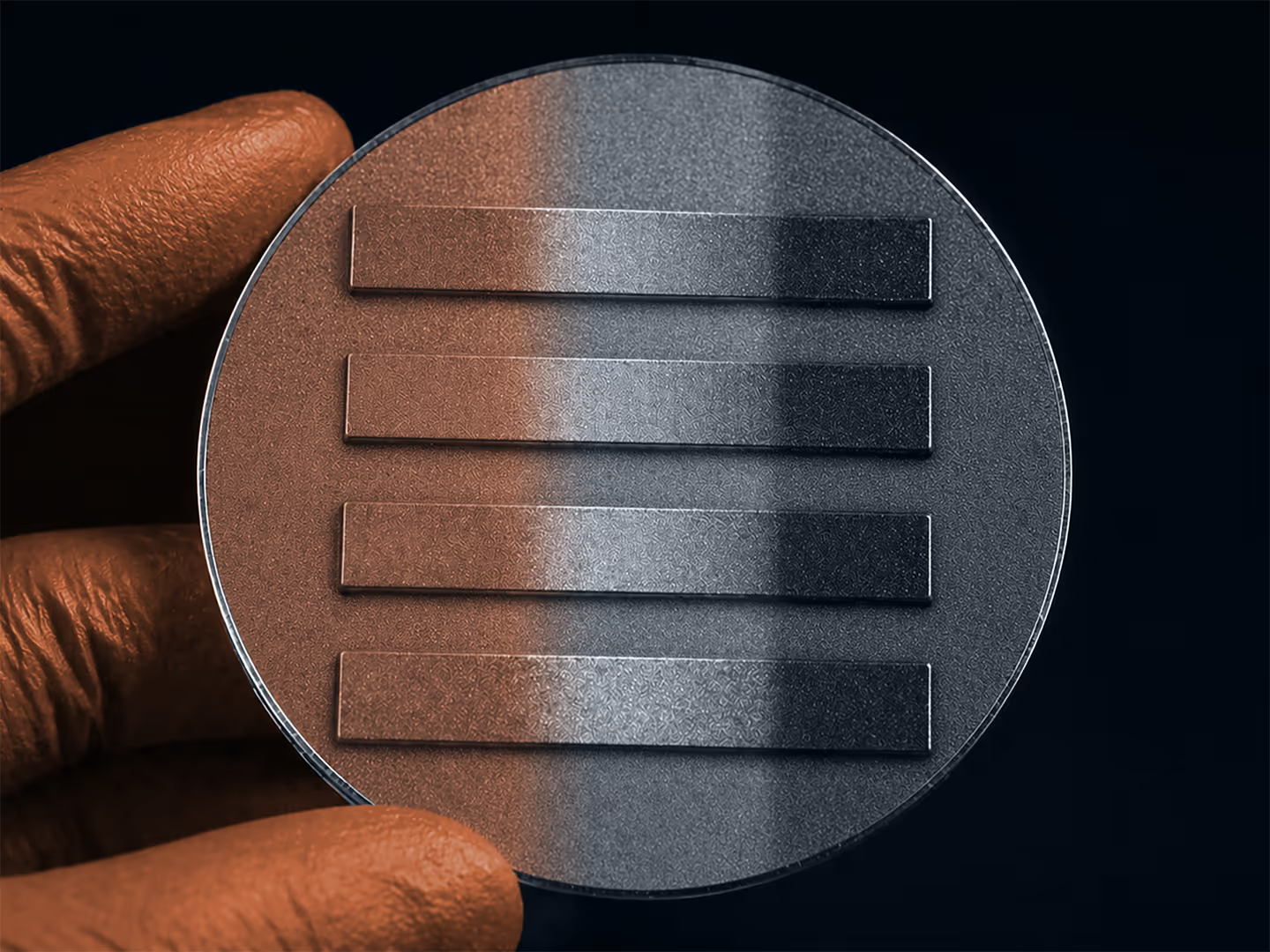
Seamlessly manufacture gradient metal components, new alloys, and ceramics using a single platform. Enabling engineers to design functionally graded, high-performance parts without the constraints of traditional single-material processes.
Supportless
Unleashing true design freedom
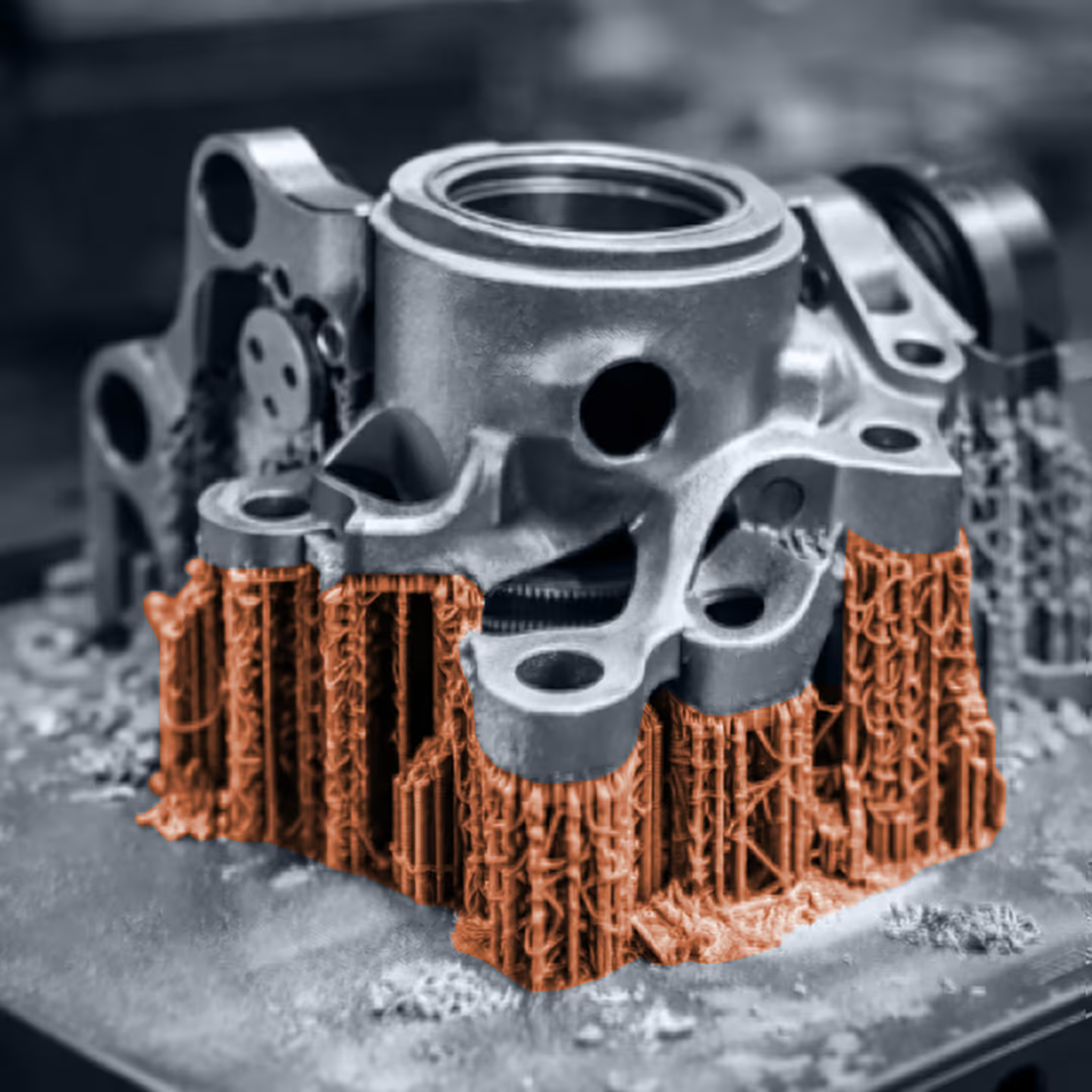
Manufacture complex geometries with minimal support requirements, reducing post-processing and material waste. Designed to enable true design freedom and support the creation of intricate features without the constraints of conventional LPBF systems.

In-space use
Redefining manufacturing beyond Earth
Our additive manufacturing process is designed to operate in vacuum and microgravity. Instead of loose powder beds, we create rigid powder layers similar to green body parts – enabling stable, on-demand production of complex components in space, including the use of locally available feedstocks.

Cheaper feedstock
Low-cost powders for high-impact results
Our process works with non-spherical, recycled, and irregular powders, eliminating the need for expensive atomized feedstock. It also enables the use of fine powders that are difficult to process reliably in LPBF, reducing sensitivity to particle shape and flowability and unlocking low-cost industrial materials on Earth as well as raw regolith for in-space manufacturing.
Industrial applications
Industrial & advanced manufacturing
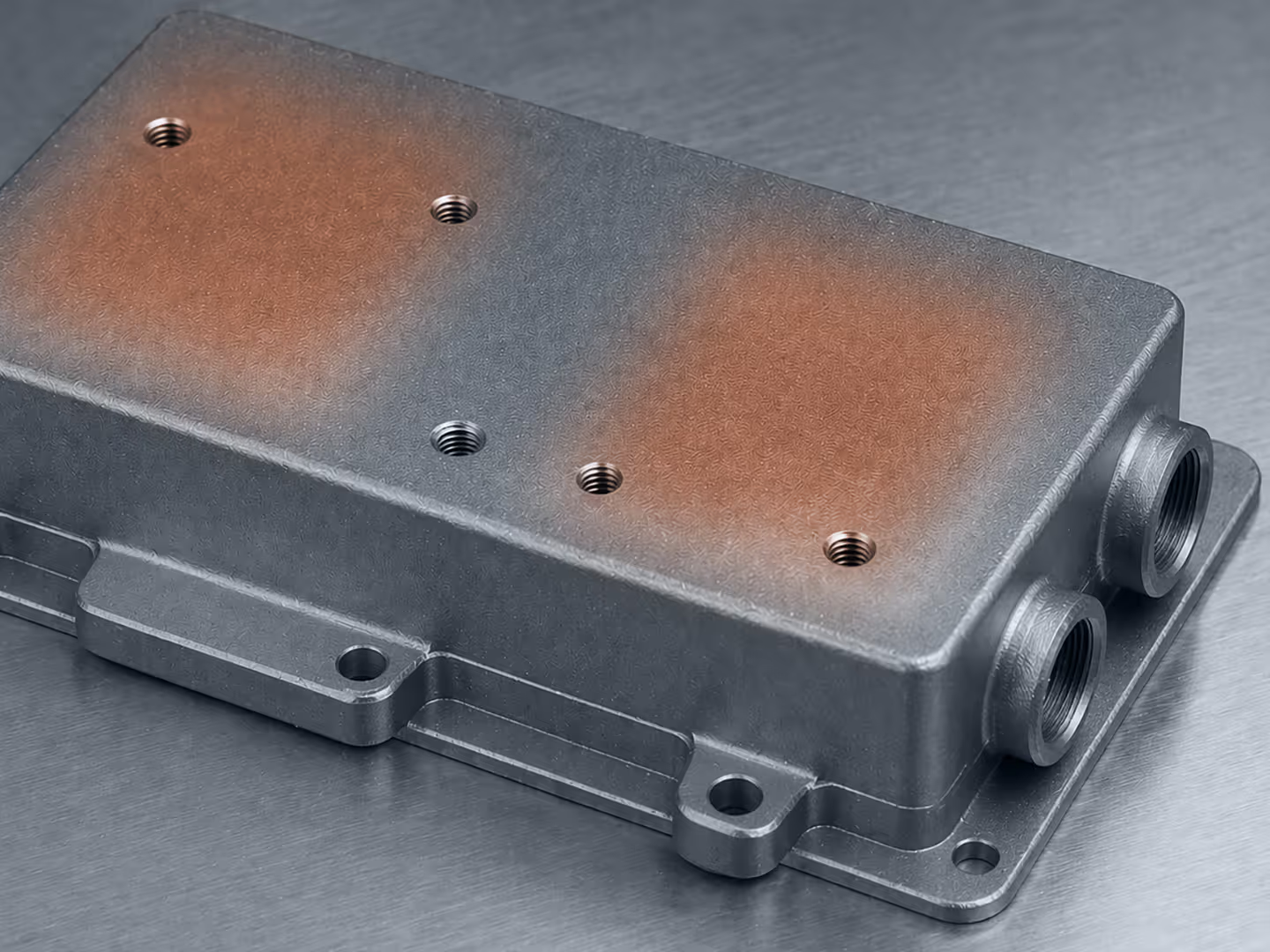
SpaceForm’s cutting-edge technology aims to redefine 3D printing in the aerospace, medical, energy, and tooling sectors through precise, multi-material manufacturing. By combining supportless printing, gradient materials, and low-cost non-spherical powders, it will reduce material costs, improve performance, and enable complex geometries previously unattainable – such as fully enclosed or hollow structures. Designed for both terrestrial and microgravity environments, it has the potential to reshape production workflows and unlock new design possibilities across critical industries.

Space applications
On-demand spacecraft maintenance
Space missions carry spare parts, yet most remain unused due to the unpredictable nature of failures. SpaceForm addresses this with an in-space, high-resolution and multi-material 3D printing solution for on-demand repairs and upgrades – reducing storage requirements, resupply missions, and response times, while increasing mission autonomy and sustainability.
Material exploration
Research & development (R&D)
We enable next-generation R&D through rapid, flexible experimentation across metals, ceramics, polymers, and advanced composites. Leveraging suspension-based additive manufacturing and low-cost non-spherical powders, researchers can iterate quickly on new alloys, graded structures, and novel material combinations – unlocking discoveries beyond the reach of conventional AM.
Our development routes & progress
From early-stage experiments to a flight-ready prototype. Our roadmap is built around one goal – making suspension-based manufacturing real.
1
2025/26
Launch & presentation
Process validation and development
2
2026/27
Supportless & multimaterial 3D printing
Technology demos
3
2028
Terrestial 3D printer
Pilot deployments & in-space demonstration
4
2029
Flight-ready 3D printer
In-space manufacturing

Dr Krzysztof Fryzowicz
CEO
Passionate about solving and overcoming complex challenges, Krzysztof brings vision, creativity, and determination, driving SpaceForm toward the future of advanced manufacturing.

Dr Hubert Pasiowiec
CTO
An expert in additive manufacturing, Hubert leads the technological development of SpaceForm’s breakthrough 3D printing solutions, ensuring innovation meets real-world applications.

Prof. Piotr Bała
CRDO
With years of experience in materials science and engineering, Piotr oversees research, development and prototyping, pushing the boundaries of multi-material and supportless 3D printing technology.

Redefining what can be built
and at what cost
Want to see what? Let’s talk!
SpaceForm is developing a novel additive manufacturing technology based on powder suspensions instead of dry powders. By combining suspension deposition, drying, and laser fusion, it aims to enable greater flexibility in materials, geometry, and cost. The approach is designed for both terrestrial and in-space manufacturing.
Instead of optimizing existing processes, SpaceForm changes the feedstock – from dry powders to suspensions. While this introduces additional complexity at the feedstock level, it enables simpler and more flexible processing, including reduced reliance on support structures, lower-cost materials, and new approaches to multi-material printing. This shift aims to unlock capabilities that are difficult or impossible with conventional powder-based systems.
Most systems, such as Laser Powder Bed Fusion, are built around dry, spherical powders, which constrain cost, geometry, and material flexibility. SpaceForm takes a different approach by using suspensions, aiming to reduce dependence on supports, enable lower-cost materials, and allow more flexible material design within a single process.
Suspensions enable more controlled material deposition and reduce particle friction during processing. After drying, powders form stable, compact powder beds. This allows process conditions not achievable with dry powders.
Support structures increase cost, time, and design constraints. SpaceForm aims to significantly reduce their use, enabling more complex geometries and simpler post-processing.
The technology is being developed primarily for metals, with strong potential for ceramics and polymers. It is designed to enable multi-material and gradient structures over time.
Applications include high-performance components (e.g. motorsport, aerospace), cooling systems, advanced electronics, and parts with locally tailored material properties. The technology is also relevant for manufacturing in space.
The core concept has been demonstrated in early experiments. SpaceForm produced a multi-layer Ti6Al4V sample using suspension-based deposition and laser fusion, confirming that the approach is technically feasible. The current focus is on improving process stability, repeatability, and part quality.
Key challenges include process stability, repeatability, and control of material properties. Optimizing laser interaction with suspension-based layers is also critical.
Additive manufacturing faces limitations in cost, materials, and process constraints. At the same time, demand is growing for advanced materials and in-space manufacturing. SpaceForm aims to address both.
By enabling lower-cost powders and reducing support structures, SpaceForm aims to decrease material use and post-processing. This will significantly improve cost-efficiency of AM unlocking new applications and manufacturing routes.
SpaceForm aims to enable parts with locally tailored properties (e.g. parts with reduced mass, higher cooling capacity or higher temperature resistance) within a single build. This allows new design approaches not possible with single-material systems, and will also reduce joints and connection interfaces.
The focus is on improving repeatability, material performance, and developing a functional prototype, along with validating multi-material capabilities.
Initial focus is on high-value, low-volume applications such as motorsport. Over time, expansion is expected into aerospace, electronics, and cooling applications.
We work with selected partners on co-development, application exploration, and early validation. Commercial systems are not yet available.